
Introduction
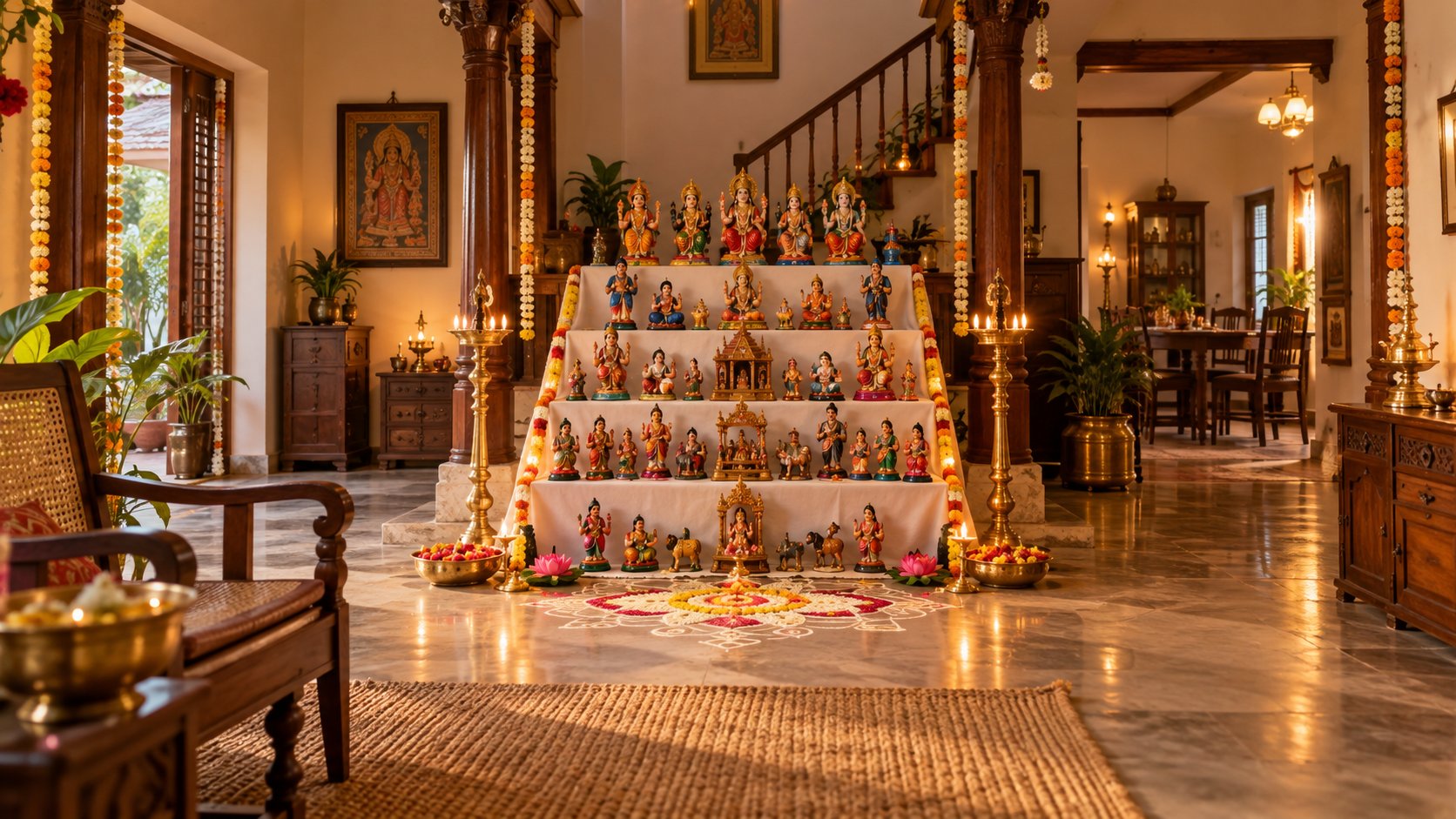
Every Navratri, homes across South India turn into small galleries. Steps are set up, covered in silk, and filled with dolls collected and handed down over generations. Then every evening, friends and neighbours visit to see the display. It is called Golu in Tamil Nadu, Bombe Habba in Karnataka and Bommala Koluvu in Andhra Pradesh and Telangana. In every form, it is one of India’s most visual home traditions.
Yet in many homes, the Golu padi (the steps themselves) is still an afterthought: a stack of boxes, borrowed planks or a wobbly metal stand that is hard to set up and harder to store. This guide covers how to plan, size and design a Golu padi. It also shows how the right design can turn your Golu into a showcase you use all year. For the wider picture, see our [Festive Home Interior Guide for Navratri, Golu, Dussehra and Diwali] [link when live].
What Is Golu?

Golu, also called Kolu or Bommai Golu, is a display of dolls and figurines arranged on an odd number of steps during Navratri. It celebrates the goddess in her many forms, and many families see it as a symbol of creation, from the divine at the top to everyday life below. Families usually set up the Golu just before Navratri begins and take it down after Vijayadashami.
The Golu is also deeply social. Visitors are welcomed each evening, often with songs, sundal (a lentil prasad) and a small thamboolam gift for women and girls. That means the display needs to be easy to view, well lit and set in a room that can welcome guests.
How Golu Steps Are Traditionally Arranged

Arrangements vary from family to family, but many follow a broad order from the divine at the top to the everyday at the bottom:
| Step | What is usually placed |
| Top step | Deities such as Ganesha, Lakshmi, Saraswati and Durga, often with a kalasam |
| Upper steps | Avatars of Vishnu, Shiva and other deities, and scenes from the epics |
| Middle steps | Saints, sages and scenes from festivals and temples |
| Lower steps | Scenes from daily life: weddings, markets, the Chettiar shop, villages |
| Bottom step | Marapachi bommai (the wooden couple dolls), toys and themed sets |
Many families also build a themed display on the floor in front of the steps. Popular themes include a park, a temple festival, a village or a scene from mythology. A good Golu padi design leaves room for this floor space, not just the steps.
How Many Golu Steps Should You Have?
The number of steps is traditionally odd, and it should match both your doll collection and your room. Families often add steps over the years as their collection grows, so it helps to plan for growth.
| Steps | Works well for |
| 3 steps | Apartments, first Golu, small collections, a corner of the living room |
| 5 steps | Most city homes; a balanced display with room to grow |
| 7 steps | Larger living rooms and well-established collections |
| 9 steps | Independent houses and dedicated Golu rooms; the traditional full Golu |
| 11 steps | Large homes and very large heirloom collections |
How to Size a Golu Padi
Before designing or buying a Golu padi, measure four things: the wall you will place it against, your ceiling height, your tallest dolls and the floor space in front. Then plan around these points.
- Step height (rise): Each step should be tall enough that dolls on the step behind remain visible. Measure your tallest dolls and leave a little headroom above them.
- Step depth: Most dolls need only a shallow step. Deeper steps hold themed sets and kalasams, but they push the unit further into the room.
- Width: Wider steps hold more dolls per row and make the display look generous. In a narrow room, an L-shaped or corner layout can add width without blocking walkways.
- Top step height: Keep the top step at a height where you can safely reach it to arrange the deities and light lamps.
- Floor space in front: Leave room for a themed floor display, for visitors to stand and for a kolam.
As a starting point, many families find that each step only needs to rise a little above the height of the dolls on it. A designer can adjust rise and depth to fit your collection, so measure your largest dolls before you start.
8 Golu Padi Design Ideas That Work All Year
The best Golu padi is not a temporary structure you dread assembling. It is a piece of furniture designed for nine nights of display and 356 days of everyday use.
1. The Stepped Bookshelf
A staircase-shaped wooden unit holds the Golu during Navratri and books, plants and decor for the rest of the year. Because it stays in place, there is nothing to assemble. During Navratri, you simply clear the shelves, drape them with silk and arrange the dolls.
2. The Golu Padi With Built-In Doll Storage
Each step is a box with a drawer or lift-up lid, so the dolls are stored inside the very steps they are displayed on. After Vijayadashami, they go straight back into padded compartments. This is one of the most practical designs for families with large collections.
3. The Modular Box Steps
Individual wooden boxes of different heights stack into a stepped Golu and separate into side tables, benches or storage cubes afterward. They suit families who rearrange often or move homes.
4. The Foldable Golu Padi
A hinged wooden or aluminium frame that folds flat after the festival is ideal for apartments. Look for sturdy locking hinges, a stable base and steps that do not flex under heavy clay dolls.
5. The Wall-Niche Golu
In new homes or renovations, a recessed wall niche with fixed stepped shelves can hold the Golu during Navratri and a curated art or collectibles display afterward. It takes no floor space and becomes a permanent architectural feature.
6. The Golu-and-Pooja Combination
A stepped display built beside or below the pooja unit links the Golu with daily worship. The top step can align with the deities in the pooja unit, creating one continuous festive focal point. See our pooja unit designs for ideas.
7. The Corner or L-Shaped Golu
An L-shaped stepped unit fits neatly into a corner and gives you more display width without pushing far into the room. It works well in living rooms where the main walls are already taken by the TV unit or sofa.
8. The Display Cabinet Golu
A glass-fronted display cabinet with adjustable shelves can be set in steps for Navratri. It protects delicate dolls from dust and little hands all year. Browse our display unit designs for inspiration.
Each of these can be built to your room’s measurements and your collection by our bespoke furniture team.
Choosing Materials for a Golu Padi

Clay and wooden dolls are heavier than they look, so strength matters as much as appearance.
| Material | Strengths | Things to consider |
| Solid wood (teak, sheesham) | Strong, long-lasting, traditional look | Heavier and more expensive |
| Plywood with veneer or laminate | Strong, stable, works for built-in and modular units | Choose a moisture-resistant grade for humid cities |
| Aluminium or steel frame | Light, foldable, easy to store | Needs a sturdy top surface and good locking joints |
| Glass shelves (in cabinets) | Protects dolls from dust, looks premium | Use toughened glass and check the load rating |
Whatever the material, the steps should not bend in the middle under a full row of dolls. Wide steps may need a central support.
Golu Lighting Ideas
Good lighting turns a Golu from a stack of dolls into a display people remember.
- LED strips under each step’s front edge light the row below evenly and stay hidden from view.
- Warm white light brings out the colours of painted clay and wood better than cool white.
- Spotlights or a picture light above the top step highlight the deities.
- Traditional lamps such as the kuthuvilakku or agal vilakku add warmth in front of the display.
- Built-in wiring in a bespoke Golu padi avoids trailing cables across the floor.
Keep oil lamps and diyas on a metal or stone tray, away from silk drapes, paper decorations and wooden edges.
Safety Tips for Your Golu Display
- Anchor tall Golu padis to the wall so they cannot tip forward, especially in homes with children or pets.
- Place the heaviest dolls on the lower steps and keep the top light.
- Use non-slip mats or a fitted cloth so dolls do not slide.
- Keep walkways clear of themed floor displays so evening visitors do not trip.
- Never leave lamps burning unattended near drapes or decorations.
Golu Ideas for Small Apartments
A small home can still have a lovely Golu. Start with three or five steps and choose a corner, L-shaped or wall-mounted design. A foldable padi or modular boxes that become side tables afterward save precious floor space. Keep the floor theme compact, and use under-step LED lighting rather than floor lamps. For more space-saving ideas, see [Diwali Decoration for Small Apartments] [link when live].
How to Store Golu Dolls After Navratri
Many families have dolls that are decades old, and some are irreplaceable. Proper storage keeps them safe until the next Navratri.
- Dust each doll gently and let it dry fully before packing.
- Wrap clay and papier-mâché dolls individually in soft cotton cloth, then bubble wrap.
- Store them upright in sturdy, padded boxes, with heavier dolls at the bottom.
- Keep boxes in a dry place, away from damp walls, bathrooms and direct sunlight.
- Label boxes by step or theme so setting up next year takes less time.
A Golu padi with built-in storage or a dedicated loft or wardrobe section makes this far easier. See our wardrobe designs and [Festive Storage Ideas] [link when live].
A Golu Padi Designed for Your Home and Your Collection
A Golu is a family’s story told in dolls, and it deserves a display built to last as long as the collection. The right Golu padi is sized to your room, strong enough for heirloom dolls, lit to bring them to life and useful long after Vijayadashami.
At Vibrant Spaces, we design and build bespoke Golu padis, display units and pooja units in our own factory, with more than 10 years of experience and a 5-year warranty on woodwork. Whether you want a foldable padi for an apartment or a built-in stepped showcase for a new home, we can design it around your space and your traditions.
Planning your Golu for next Navratri, or a display that works all year? Schedule a consultation with our designers.
Frequently Asked Questions
Why does a Golu have an odd number of steps?
Tradition holds that the steps should be odd in number, most commonly three, five, seven or nine. Families choose the number based on their collection, space and custom, and many add steps over the years.
What goes on the top step of a Golu?
The top step usually holds deities such as Ganesha, Lakshmi, Saraswati and Durga, often with a kalasam. Lower steps move through saints, festival scenes and daily life, with the marapachi dolls often placed at the bottom.
When is Golu set up and taken down?
Most families set up the Golu just before Navratri begins and dismantle it after Vijayadashami. Exact customs vary by family and region.
Can a Golu padi be used after Navratri?
Yes. A well-designed Golu padi can work as a stepped bookshelf, a display unit, modular side tables or storage for the dolls themselves, so it is useful all year.
What is the best material for a Golu padi?
Solid wood and moisture-resistant plywood are strong and long-lasting, and they suit built-in or permanent units. Aluminium or steel frames are lighter and fold flat, which suits apartments with limited storage.
How many steps are right for an apartment?
Three or five steps suit most apartments. Corner, L-shaped, wall-mounted and foldable designs help you fit a full display into a small living room.




Leave A Comment