
Introduction
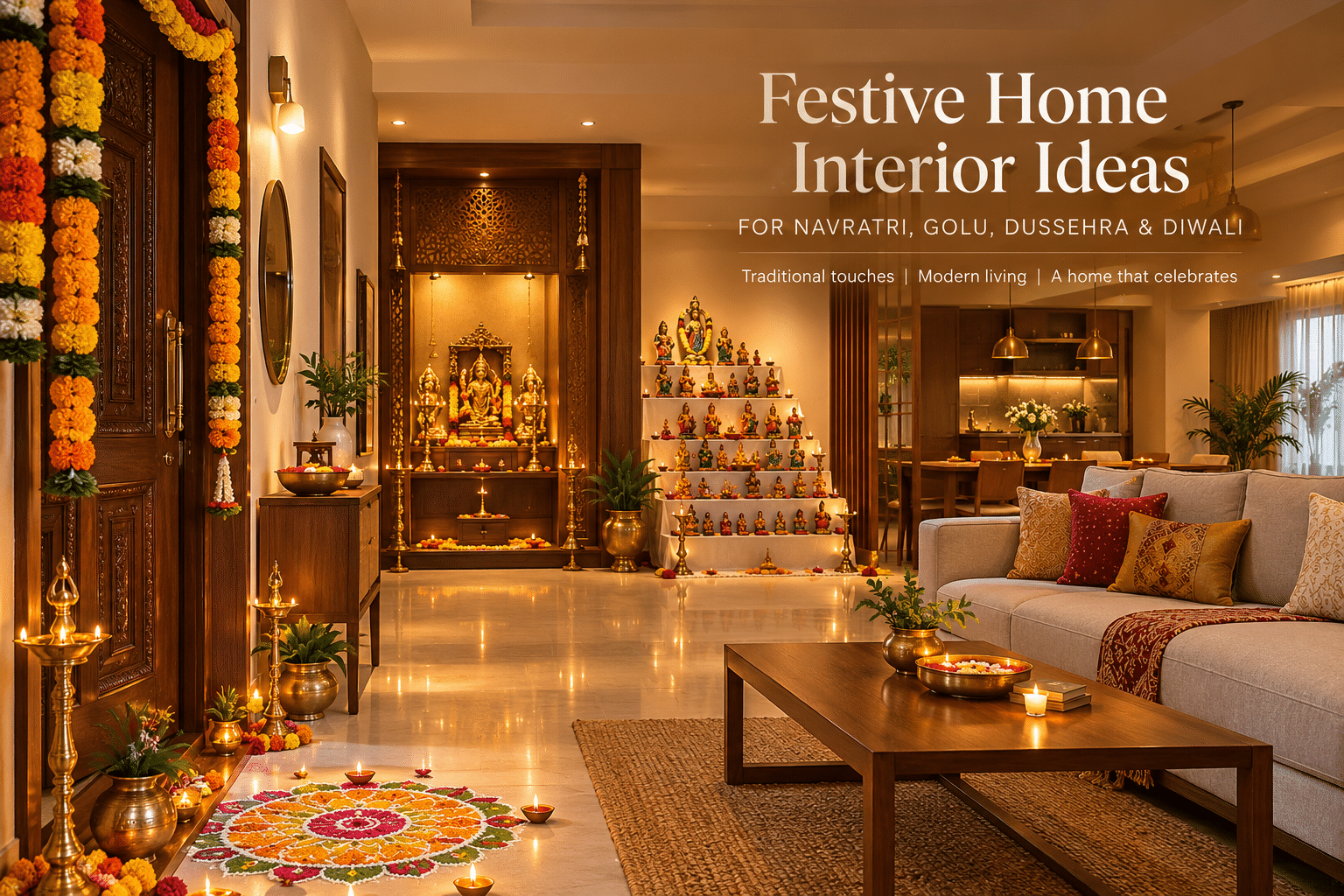
From Navratri and Golu to Dussehra and Diwali, India’s festive season is when the home matters most. Families gather for prayers, guests drop in every evening, and every room gets used more than usual. In Delhi, that may mean a Lakshmi puja setup and torans at the door. In Chennai, it may mean a nine-step Golu, a lit kuthuvilakku and a kolam at the entrance.
A festive home does not have to depend on temporary decorations. The homes that feel most special during the festivals are the ones where pooja spaces, display units, lighting, furniture and storage are designed to support these traditions all year. This guide covers festive home interior ideas for Navratri, Golu, Dussehra and Diwali (Deepavali), for both North and South Indian homes, whether you live in an independent house or a compact apartment. If you are planning bigger changes, start with our guide to a [Diwali home makeover] [link when live].
Why Festive Interior Design Matters
Festivals put your home to a practical test. Before you decorate, ask a few questions:
- Does your entrance feel welcoming, and is there room for a rangoli or kolam?
- Can guests move comfortably around your living and dining areas?
- Is your pooja area comfortable, well lit and connected to the rest of the home?
- Is there a place for Golu, a Lakshmi puja setup or festive displays without crowding a room?
- Can your kitchen handle a week of sweets, savouries and family meals?
- Where will the diyas, lights and Golu dolls go once the season ends?
The answers show where your home needs festive styling and where it needs better design.
1. Diwali and Navratri Entrance Decoration Ideas
The entrance is the first thing guests see, and it sets the tone for the whole home. North Indian homes often welcome Diwali with a marigold toran and a pair of diyas at the door. South Indian homes favour a fresh kolam, a mango-leaf thoranam and a brass lamp at the threshold.
For a contemporary home, keep the base simple and add one or two statement elements rather than layering everything at once. A permanent foundation makes seasonal styling easier every year. That could be a slim console for diyas and flowers, a carved wooden door frame, a jaali screen or warm accent lighting above the doorway. Leave a clear patch of floor at the threshold so a rangoli or kolam has room without blocking the door swing.
2. Bring Navratri and Diwali Colours Into Contemporary Interiors
Festive colour changes a room’s character quickly, and you do not need to repaint to use it. Each of the nine days of Navratri is associated with a colour, a practice especially popular in Maharashtra and Gujarat. These colours can come in through cushions, flowers, rugs, curtains, table linen and artwork. For Diwali, gold, ivory, deep red, earthy brown and jewel tones create a rich, warm atmosphere.
Colour works best when it complements the materials already in the room:
- Wood pairs well with gold, ochre and earthy tones.
- Marble suits ivory, soft pastels and metallic accents.
- Neutral walls can carry stronger festive colours through accessories.
- Brass adds warmth without a full design change.
For a day-by-day palette, see [9 Navratri Colours, 9 Interior Ideas: Festive Colour Palettes for Your Home] [link when live].
3. Pooja Room Design for Navratri and Diwali
The pooja area becomes the centre of the home during Navratri, Golu and Diwali, so it deserves a permanent design rather than a temporary festive corner. In a North Indian home, it may need space for kalash sthapana, an akhand jyoti that burns through all nine nights of Navratri, and a Lakshmi-Ganesh setup at Diwali. In a South Indian home, it may centre on a kuthuvilakku, brass vessels and daily kolam in front of the unit.
Depending on the space available, the pooja area could be:
- A dedicated pooja room
- A compact floor-standing pooja unit
- A wall-mounted mandir for apartments
- A traditional carved wooden temple
- A contemporary prayer niche within the living or dining area
Carved wood, brass bells, jaali doors and warm lighting add character. Clean lines and concealed drawers for lamps, oil, incense and puja vessels keep the space practical. Good ventilation matters too, especially for an akhand jyoti or daily incense.
Browse our pooja unit designs or read [Pooja Room Designs for Navratri & Diwali: 12 Mandir Ideas for North & South Indian Homes] [link when live].
4. Golu Display Ideas for Modern Homes
For many families in Tamil Nadu, Karnataka and Andhra Pradesh, Navratri means Golu, also called Kolu or Bommai Golu. Dolls and figurines are arranged on an odd number of steps, usually three, five, seven or nine. Neighbours and relatives visit each evening, which makes the Golu one of the most-viewed spaces in the home.
Many families still build a temporary setup from boxes and planks every year. A purpose-built Golu padi works better. It should be:
- Sized to the room and the number of steps your family uses
- Strong enough to hold heavy clay and wooden dolls
- Quick to assemble and dismantle
- Easy to reach for daily arranging and lighting
- Compact to store, or designed to stay out all year
A well-designed Golu padi can become a bookshelf, a collectibles display or a stepped storage unit for the rest of the year. Our bespoke furniture team can design one around your room. For more ideas, read [Golu Padi Ideas: Designing a Golu Display That Becomes a Year-Round Showcase] [link when live].
5. Dussehra Decoration at Home: Ayudha Puja, Saraswati Puja and Vijayadashami
Dussehra closes the Navratri season, and each region marks it differently at home. In South India, Ayudha Puja honours the tools of daily life: vehicles, machines, kitchen equipment, laptops and work desks are cleaned, decorated with sandalwood paste, kumkum and flowers, and worshipped. Saraswati Puja places books, musical instruments and study materials before the goddess. On Vijayadashami, children often begin learning in a ritual called Vidyarambham, and the Golu is wound up.
These rituals favour certain spaces. A well-organised study corner or home office becomes the setting for Saraswati Puja. A clear, washable surface near the entrance or utility area makes Ayudha Puja easier. In North India, Vijayadashami marks Ravana’s defeat and the shift from Navratri to Diwali preparation. Many families use the days after Dussehra to deep-clean, declutter and plan their Diwali setup.
For a home that moves smoothly from Navratri to Diwali, plan storage that lets you pack away Golu or Navratri items quickly and bring out Diwali lights and diyas with little effort.
6. Diwali Living Room Ideas for Festive Hosting
AK_230129_94897.jpg
The living room is where most festive visits happen, so start with how it works before you decorate. Can people move comfortably around the seating? Is there a surface for sweets and tea? Do décor pieces compete with each other? Does the lighting work for both daytime visits and evening gatherings?
Often you do not need new furniture. A festive refresh can come from:
- Rearranging seating to open up movement
- Swapping in festive cushions and throws
- Fresh flowers and a styled centre table
- One display wall or shelf for brass, art or diyas
- Warm ambient lighting in the evening
If you are planning a bigger change, furniture and storage can be designed around how your family actually uses the room. See [Diwali Living Room Ideas: Create a Festive Space for Family and Guests] [link when live].
7. Diwali Lighting Ideas for Every Room
Lighting changes a room faster than anything else. Diyas and candles remain central to Diwali and Deepavali, and in many South Indian homes the brass kuthuvilakku is lit through the season. Pair these with layered architectural lighting:
- Ambient lighting for overall illumination
- Accent lighting to highlight artwork, niches, display units or a Golu
- Cove lighting for a soft glow along ceilings or behind furniture
- Pooja lighting to give the prayer area warmth and focus
- Decorative lighting such as diyas, lanterns and string lights
The goal is depth and warmth, not just brightness. Keep safety in mind as well. Place diyas and candles away from curtains, cushions, wooden surfaces and paper décor, and use a metal or stone tray beneath them. For more ideas, read [Diwali Lighting Design Ideas: Beyond Diyas to Cove, Accent & Pooja Lighting] [link when live].
8. Festive-Ready Dining and Kitchen Spaces
Festivals mean bigger meals, longer conversations and a kitchen that works overtime on sweets and savouries. In the dining area, keep décor light enough that it does not get in the way of eating:
- A simple table runner and a low centrepiece
- Warm pendant or accent lighting over the table
- A sideboard or counter that keeps serving dishes within reach
- Clear walkways around the table for larger family gatherings
The kitchen faces even more pressure, from murukku and laddoos to Diwali faral and family feasts. A well-planned kitchen should offer enough preparation space, organised pantry storage, easy access to large vessels and festive cookware, sensible appliance placement and a short path from the stove to the dining table.
A modular kitchen designed around these needs makes festive cooking easier and continues to work efficiently all year. Read [Festive-Ready Modular Kitchen: Design Ideas for Diwali Cooking & Hosting] [link when live].
9. North and South Indian Festive Traditions in Your Interior
Indian festive homes are wonderfully diverse, and the same idea often has a regional counterpart:
| Element | North Indian homes | South Indian homes |
| Floor art | Rangoli in powder colours and flowers | Kolam in rice flour, often drawn daily |
| Doorway | Marigold toran | Mango-leaf thoranam |
| Lamps | Clay diyas, akhand jyoti | Brass kuthuvilakku, agal vilakku |
| Navratri focus | Kalash sthapana, Durga worship, garba and dandiya | Golu display, evening visits |
| Diwali focus | Lakshmi puja, Dhanteras shopping | Naraka Chaturdashi oil bath, early-morning Deepavali |
You do not need to recreate every tradition in one home. Choose the elements that hold meaning for your family, and let them sit comfortably within the home’s design language. A contemporary apartment can celebrate tradition just as well as an ancestral house. Families from different regions living together can also blend both, for example a kolam at the door and a marigold toran above it.
For a deeper look, read [From North to South: Rangoli to Kolam, Toran to Thoranam, How Indian Homes Celebrate] [link when live].
10. Blend Traditional Materials With Contemporary Design
The festive season is a natural moment to bring Indian craftsmanship into the home. A traditional material does not need a traditional room. A brass accent can sit well beside minimalist furniture, and a wooden jaali partition can connect a modern apartment to Indian architecture.
Materials and details worth considering include brass lamps and hardware, teak and other solid woods, Athangudi tiles from Chettinad, carved Chettinad-style pillars, jaali screens and Rajasthani jharokha-inspired niches. Used with restraint, they make a home feel rooted without looking dated.
See [Traditional Meets Modern: Brass, Teak, Athangudi & Jaali in Contemporary Indian Interiors] [link when live].
11. Festive Decoration for Small Apartments
In a compact home, decorate selectively and think vertically. Ideas that work well include:
- Wall-mounted display units and floating shelves
- Compact or wall-mounted pooja units
- Multi-functional furniture, such as storage benches and nesting tables
- Foldable Golu steps that pack flat after Vijayadashami
- Vertical and wall-washer lighting instead of floor lamps
- A few well-chosen tabletop accessories rather than many
A small home can feel festive and luxurious when every element has a purpose. Read [Diwali Decoration for Small Apartments: Smart Furniture and Space-Saving Ideas] [link when live].
12. Choose Festive Pieces That Last, and Know When to Stop
A common festive mistake is buying pieces that have no use once the season ends. Choose elements that move easily into everyday life. A display unit can hold the Golu during Navratri and collectibles afterward. A console can carry diyas at Diwali and keys and flowers the rest of the year. A pooja unit stays a permanent spiritual space. For pieces built around both festive gatherings and daily life, see [Festive Furniture for Indian Homes: Pieces That Work Long After Diwali] [link when live].
Restraint matters as much as choice. Pick one focal point per room, such as the pooja area, the Golu, a festive dining table or a lighting installation, and let the rest of the room breathe. Neutral walls and natural materials make festive accents stand out more. Read [Minimalist Festive Interiors: An Elegant Indian Home Without Overdoing It] [link when live].
13. Plan Storage Before the Festive Season
Festive décor needs a home once the celebrations end. Diyas, lanterns, string lights, Golu dolls, rangoli colours, brass items and festive textiles quickly become hard to manage without a plan. Delicate Golu dolls in particular need padded, dry storage to last for generations.
Plan dedicated space for seasonal items in lofts, deep drawers, display units or wardrobes, and label boxes by festival so next year’s setup takes minutes rather than hours. Read [Festive Storage Ideas: Where to Keep Golu Dolls, Diyas & Decor All Year] [link when live].
How Early Should You Start Interior Work Before Diwali?
It depends on the scale of the change. Styling, rearranging, soft furnishings and lighting accessories can be done in the final week. A new pooja unit, Golu padi or display unit usually needs several weeks for design, manufacturing and installation. A full-home interior project takes longer still.
If you are moving into a new home or planning a housewarming during the auspicious season, start the conversation early. Our [Griha Pravesh interior checklist] [link when live] covers what to plan and when.
Design a Home That Celebrates Every Festival
Festive interiors are not a choice between traditional and contemporary design. The best ones balance both, with a pooja space you use every day, a Golu display that becomes a showcase, lighting that sets the mood and storage that keeps the home calm once the season ends.
At Vibrant Spaces, we have spent more than 10 years designing homes around how families live and celebrate. Every pooja unit, display unit, wardrobe and piece of bespoke furniture is made in our own factory, and our woodwork comes with a 5-year warranty. From full-home interiors to a single pooja unit, we design spaces where tradition and everyday function work together.
Based outside Chennai? Spayci, our AI-powered virtual design lab, lets you design your home with us from anywhere in India.
Ready to plan your festive home? Schedule a consultation with our designers.
Frequently Asked Questions
What is Golu, and how is it arranged?
Golu, also called Kolu or Bommai Golu, is a Navratri tradition in Tamil Nadu, Karnataka and Andhra Pradesh. Dolls and figurines are arranged on an odd number of steps, usually three, five, seven or nine, with deities at the top and scenes from daily life below. It is dismantled after Vijayadashami.
How can I make my home festive without a full renovation?
Focus on lighting, soft furnishings and one focal point per room. Rearranging furniture, adding warm accent lighting, styling the pooja area and using festive colours through cushions, flowers and linen can transform a home within a few days.
Where should a pooja unit be placed in an apartment?
Many families prefer the north-east corner, following Vastu. In apartments, a wall-mounted or compact pooja unit in the living or dining area works well. It should be well lit, ventilated and kept away from bathroom walls.
How early should I start interior work before Diwali?
Styling and décor can be done in the final week. Custom pieces such as a pooja unit, Golu padi or display unit usually need several weeks for design and manufacturing, so start planning well before the festival.
How do North and South Indian homes decorate differently for Diwali?
North Indian homes typically use rangoli, marigold torans, clay diyas and a Lakshmi puja setup. South Indian homes celebrate Deepavali with kolam, mango-leaf thoranams, brass lamps such as the kuthuvilakku, and an early-morning oil bath on Naraka Chaturdashi.
How should I store Golu dolls and festive décor?
Wrap delicate dolls individually in soft cloth or bubble wrap and store them in dry, padded boxes away from humidity. Label boxes by festival and keep them in lofts, deep drawers or dedicated storage units so they are easy to find next year.




Leave A Comment